Introduction
Most read-later tools own the database and bolt AI onto the side. uShelf takes the opposite approach:
- Your files are the product. Every completed item lives as portable, readable Markdown.
- Your agent does the thinking. uShelf exposes an MCP server and recipe-driven workflows, not a bundled model.
- Capture stays deterministic. Web sources are extracted, sanitized, normalized, and checked before enrichment begins.
- The index is disposable. SQLite FTS5 makes the library fast to search and can always be rebuilt from Markdown.
- Reading is first-class. The web reader tracks inbox, reading, read, and archived states, plus scroll progress.
How it works
Section titled “How it works”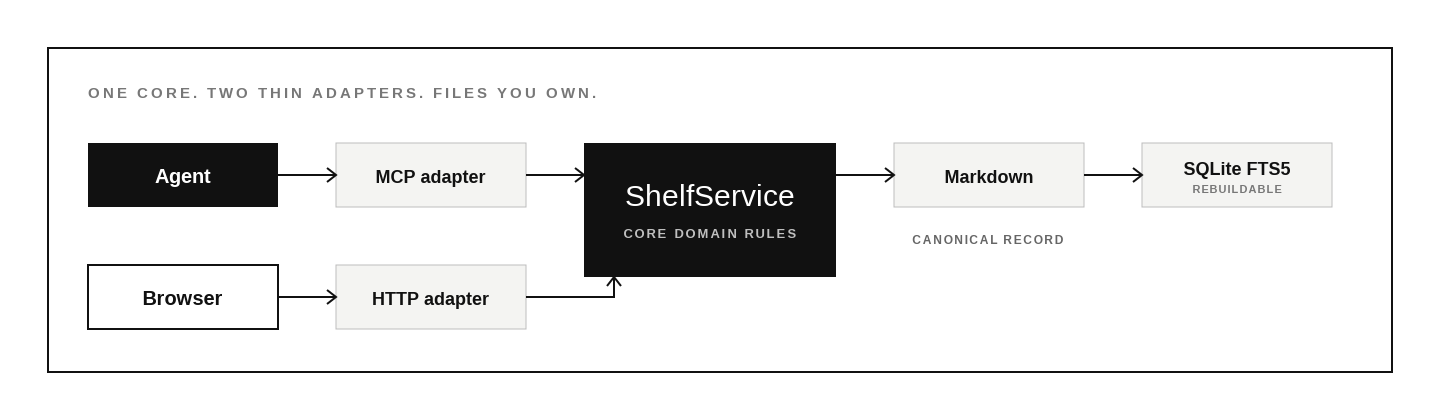
- Ask your connected agent to save something from the web or attach a PDF.
- uShelf captures and normalizes the source with deterministic code.
- The agent follows a versioned recipe to add a short description and tags.
- You search and read everything in the web app, while the canonical record stays in Markdown.
What is supported
Section titled “What is supported”Articles use Readability. Attached PDFs use PDF.js to extract text and embedded figures. X has limited public extraction, with agent-supplied fallback content. uShelf also captures images locally and blocks unsafe URLs.
Web pages are extracted in an isolated worker with a 512 MiB memory budget and a one-minute time limit, and pages that exceed either fail extraction.
PDF attachments must be at most 10 MiB and contain embedded text. Extraction runs in an isolated worker with a 512 MiB memory budget and a two-minute time limit, and PDFs that exceed either are rejected. Embedded images larger than 25 megapixels are skipped. Remote PDF URLs, OCR, vector-diagram reconstruction, complex multi-column layouts, DOCX, and PPTX are unsupported.
Next steps
Section titled “Next steps”- Install the CLI and run a library in a few minutes.
- Learn how the pieces fit together in Architecture.